Rice Cream: what it is and why it’s a pantry basic
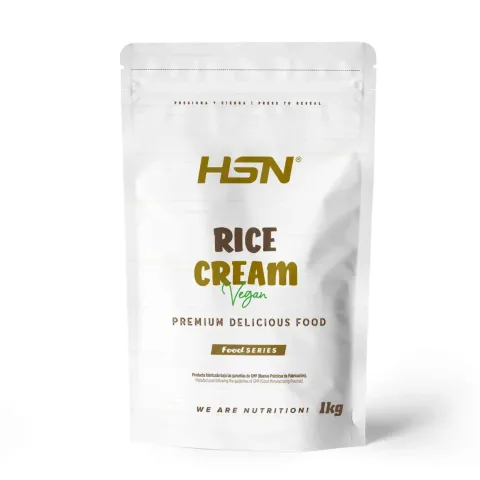
FoodSeries Rice Cream is pre-cooked rice flour, with sweetener in the flavored versions.
The raw material starts from raw rice flour that goes through a cooking process (pre-cooking) and then is turned back into powder. That way you can use it straight away: when hydrated, it thickens and has a really nice creamy texture. It’s one of those bases that save your breakfasts and snacks: quick, neutral if you want, and easy to adapt to whatever you’re craving that day.
A spoon-ready cream in seconds, perfect for turning “something simple” into a full breakfast or dessert.
What it’s NOT: neither hydrolyzed nor raw flour
It’s not hydrolyzed flour
This version is not hydrolyzed. If you’re looking for a flour with hydrolysis (ideal to take before training as an easily digestible carbohydrate source, with low gelatinization capacity), HSN has the specific product: Hydrolyzed Rice Flour.
It’s also not raw flour for cooking
It’s not “plain” rice flour for cooking in a pan/pot or for baking recipes as the main ingredient. For that, there’s: Raw Rice Flour.
So, what is it?
It’s rice flour that has already been pre-cooked so that when mixed with liquid, it thickens without needing to cook. That’s why it’s so handy for everyday use.
Texture and creaminess: why it turns out so good
A smooth, lump-free cream
Since it’s pre-cooked, it blends really well with water or milk and the texture tends to be smooth and even, perfect for eating with a spoon, although if you dilute it a lot, you can make a creamy shake to drink.
Great hydration capacity: it goes further
One of its strong points is that it absorbs a lot of liquid, so you can get a thick cream using less powder. This helps you adjust the recipe to your taste without having to use large amounts of product.
A mild flavor that doesn’t overpower
The unflavored version has a very neutral profile. That makes it fit with everything: from cocoa or cinnamon to yogurt, fruit, or nut creams.
- Quick creaminess when hydrated.
- Good consistency with little amount, thanks to its hydration.
- Neutral flavor (in the unflavored version) to mix without limits.
Nutritional values explained simply
Mainly carbohydrates
It’s an energy base: provides around 80 g of carbohydrates per 100 g (varies slightly depending on flavor), ideal when you want a meal with carbs in a convenient way.
Very low sugars
Sugars are low (0.5 g per 100 g in the unflavored version). Since it’s not a hydrolyzed product, the natural release of sugars from starch is minimal and you control it with the ingredients.
It has protein, but it’s not a “protein cream”
It provides 7.5 g of protein per 100 g (natural rice proteins), which is a nice bonus, but its main role is still to provide carbohydrates. Rice cream is often combined with protein powders to boost its “protein” aspect.
How to prepare it: the key detail of gelatinization
What happens when you mix it with water
When you mix it with water, the gelatinization process starts: the starch hydrates and the mixture thickens in seconds.
Important: it keeps thickening even if you stop shaking
This process doesn’t stop when you stop the shaker. If you shake it for a long time, it can thicken inside the mixer.
In practice, about 5 seconds of shaking is usually enough for it to blend well. Then pour it into a bowl, still liquid, and let it finish thickening.
Gluten-free “porridge”: a tasty alternative to oats
If you like oat porridge but want a gluten-free option, this cream is a perfect alternative: same idea of a warm, creamy breakfast with toppings, but made from rice.
Sweet ideas for everyday
Bowl with fruit and toppings
Cream base + fruit (banana, berries, apple) + cinnamon/cocoa + nuts or nut cream. It’s the typical breakfast you crave and make in a flash, plus it fits perfectly with different moments of physical or sports preparation.
Custard-like texture
If you adjust the liquid, you can get a texture that reminds you of custard. It goes great with our powdered flavorings.
Quick mugcake
Mix with egg, pure cocoa and sucralose, then microwave: a quick rice-based cake.
Savory ideas (if you want to break the usual)
Soft “polenta”-style cream
Adjust the density, add salt and spices, and serve with sautéed veggies, mushrooms, or a protein like chicken.
To thicken creams and soups
It can work as a mild thickener to give more body to a vegetable cream without adding other ingredients.
Combinations with healthy foods at HSN
With cocoa and nut cream
Mix with cocoa or defatted cocoa and finish with a spoonful of nut creams. It feels like a “dessert” without being heavy.
With fruit and cinnamon
A classic that always works: banana or apple + cinnamon. If you want to switch it up, try lemon zest or vanilla.
With toppings and syrups
To change the flavor without hassle, use toppings and syrups depending on what you’re craving.
Can it be mixed with protein powder? Yes
If you want to customize the amounts
You can combine rice cream with your protein powder to boost the protein content of your serving.
If you prefer the “all-in-one”
Use by athletes
An easy way to increase carbohydrate intake
For those who train, it can be an easy way to include carbs in a breakfast or snack, especially when you want something spoonable, easy and quick to prepare.
On high expenditure days or when it’s hard to eat
Since it’s easy to prepare and eat, it fits well when you want energy comfortably without resorting to heavier options. It’s often a carb source used by athletes during volume training phases to increase calorie intake.
Frequently asked questions about rice cream
Do I have to cook it?
No. It’s designed to be used straight away: it thickens when mixed with liquid, but if you like it warm, you can mix it with hot liquid or heat the mixture in the microwave.
Why does it get too thick for me?
Because it hydrates a lot and keeps thickening a few seconds after mixing. Adjust the liquid according to the recommended proportions on the label and avoid shaking too long.
Can I have it cold?
Yes. Although it works well cold; warm is more comforting and usually the preferred way to have it.
What are the best flavors?
Flavors are a very personal thing, you can find all kinds of flavors for your tastes and preferences, but we recommend not missing out on: Custard and Chocolate.
Want to know more?
- Li, C. (2022). Recent progress in understanding starch gelatinization—An important property determining food quality. Carbohydrate Polymers, 293, 119735.
- Wang, S., & Copeland, L. (2013). Molecular disassembly of starch granules during gelatinization and its effect on starch digestibility: A review. Food & Function, 4, 1564–1580.
- Singh, J., Dartois, A., & Kaur, L. (2010). Starch digestibility in food matrix: A review. Trends in Food Science & Technology, 21(4), 168–180
- Wang, S., Li, C., Copeland, L., Niu, Q., & Wang, S. (2015). Starch retrogradation: A comprehensive review. Comprehensive Reviews in Food Science and Food Safety, 14, 568–585.
- Oh, H., Nam, J.-H., Park, B.-R., Kim, K. M., Kim, H. Y., & Cho, Y. S. (2024). Physicochemical and rheological properties of ultrasonic-assisted pregelatinized rice flour. Ultrasonics Sonochemistry, 109, 106977.
- Na Nakorn, K., Tongdang, T., & Sirivongpaisal, P. (2009). Crystallinity and rheological properties of pregelatinized rice starches differing in amylose content. Starch/Stärke, 61(2), 101–108.
- Puspitowati, S., & Driscoll, R. H. (2007). Effect of degree of gelatinisation on the rheology and rehydration kinetics of instant rice produced by freeze drying. International Journal of Food Properties, 10(3).