If you’ve heard about “NAD+”… here’s where it all starts
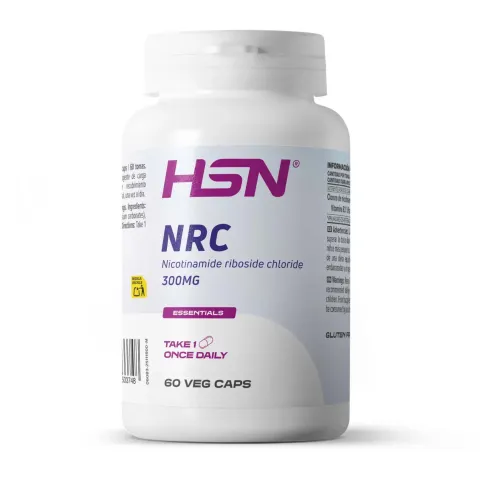
NRC (nicotinamide riboside chloride) 300mg from EssentialSeries is a dietary supplement based on vitamin B3.
Nicotinamide riboside chloride (also known as NR or NR chloride) is a form of vitamin B3 that’s a precursor to NAD+. And when we talk about NAD+ (and its partner NADH, a familiar face in the catalog), we’re talking about one of those “base” molecules involved in almost everything in the body. That’s why NRC is often used by people looking for exactly this.
NRC is a next-generation source of vitamin B3.
What NRC 300mg brings you. Transparency and quality
300mg of nicotinamide riboside chloride
Here the star is NRC: 300mg per capsule, in chloride form. This form isn’t just a whim: it’s considered the market standard in top-quality formulations, based on scientific debates about “quality/stability” around NR.
Vitamin B3 equivalence
Plus, this amount provides 126mg of vitamin B3 (niacin), which explains why NRC is used as a source of this vitamin on its own. In practice, the key is to understand it like this: it’s B3, but with a very appreciated connection to NAD+.
Clean label, a real NRC product
We’ve developed our formula using magnesium carbonates as a filler (to improve powder flow and handling, since NRC is quite tricky to work with due to its properties) and a vegetable capsule made of hydroxypropyl methylcellulose. In short: a comfy capsule and a formula focused on NRC, without a never-ending list of additives that distract you from what really matters.
Properties of NRC as a source of B3
- Niacin contributes to normal energy metabolism.
- Niacin helps reduce tiredness and fatigue.
History and fun facts explaining why NRC “is not just another one”
From an unknown molecule to the “star” of NAD+
NRC was a relatively quiet molecule for years. The game changer came when it was described as related to NAD+.
Is it in foods?
Yes: it’s been described as a trace nutrient in foods, especially present in milk. But it appears in small amounts in the diet, so when people want to take advantage of NRC’s properties, they use it isolated.
Why “chloride” is the preferred form
In supplements, the NR 'chloride' form is the most sought after. Because NR itself is famous for one thing: its stability is delicate. The chloride pairs with nicotinamide riboside, significantly improving its stability.
“Precursor to NAD+”: what you’re really after
NRC isn’t felt... it’s measured!
Lots of people take NRC expecting to “feel something” like with a stimulant, but the interesting part is different: the focus is on measuring biomarkers to check how it’s working, without relying on subjective feelings but on objective data.
NAD metabolome: the language of expert users
In scientific outreach, the NAD metabolome is trending: not just the measurement of NAD+, but the whole set of related metabolites. This is one way to check NRC’s impact on your body, unlike other forms of vitamin B3 like nicotinamide or inositol hexanicotinate.
NR (NRC) vs NMN: the eternal comparison. We break it down for you
The real question: which one’s better?
Though the debate and reasoning are complex, in practice the conclusion is: they end up converging.
The choice between the two usually depends on: trust, tolerance, price, stability, and availability. NRC has earned its spot in our catalog as the standard related to NAD+, with an unbeatable quality-price ratio.
In short:
NRC is the gateway to NAD+. NMN is also an interesting molecule, but in practice the comparison isn’t always “one wins and the other loses”: often it’s “which fits better,” and for that NRC is the clear winner in most common cases.
Why it’s a premium ingredient
Raw material: quality you can tell
NRC isn’t a standard vitamin B3. It’s an ingredient that demands more control in production and handling due to its characteristics and properties, which significantly impacts raw material cost. If you compare prices with other forms like nicotinamide, remember NRC goes further, and if you just want a niacin boost, other forms might be more affordable.
NRC also gets the “invisible” care
A big part of handling NRC at HSN is the “invisible” work: We’ve done a careful raw material selection backed by months of research, quality controls, and chosen a formulation approach focused on keeping the ingredient free of unnecessary additives.
The “methylation stack”: NRC + TMG (betaine) and B vitamins
Where the idea comes from
In the community, there’s debate about whether using NRC to influence NAD+-related pathways might increase “traffic” of nicotinamide and its metabolites, potentially affecting methylation reactions in some cases. That’s why pairing NRC with methyl donors became popular.
How betaine fits in here
If you want to follow this trend, a typical combo is Betaine HCl Complex alongside NRC. It’s a simple way to complement a classic stack.
And what about B vitamins?
It’s also common to see NRC paired with other B vitamins, so you can combine it with Ultra B-Complex or B-50 Complex, our B vitamin complexes.
Stability and storage: the detail that sets a good NRC apart
Why NRC is so unstable
NRC is known to degrade under certain conditions (especially when exposed to water and heat). That’s why you’ll see debates about formulation, transport, and storage: at HSN we’ve taken all this into account to formulate a quality NRC-based product.
What this means in practice
There are formulation criteria that really matter: solid format and 100% dry handling of the powder, humidity control, packaging in an opaque container that protects from light and heat. At HSN our approach is clear: prioritize total ingredient stability in its proper form, so you can fully enjoy its benefits.
How to store NRC at home
- Keep it in a cool, dry place, away from heat sources. Refrigeration isn’t necessary or recommended.
- Close the container tightly after each use and avoid leaving it open.
- Don’t store it in humid places (bathroom/kitchen near steam). A shelf in a room or pantry is usually ideal.
Q&A about Nicotinamide Riboside
Quick questions and answers (Q&A)
Is it the same as NADH? What’s the difference?
No, it’s not the same. NADH is one form of the NAD+/NADH pair. Meanwhile, NRC is a precursor to NAD+.
Simply put: NRC is raw material for your NAD+ pool, while NADH is one of the forms that molecule takes in the body.
Is it useful for athletes?
It can fit, especially if you’re looking for nutritional support linked to daily training. The key here is the properties of vitamin B3, which: contributes to normal energy metabolism and helps reduce tiredness and fatigue.
In practice, many athletes use it during loading phases, intense weeks, or simply to take care of the “base” (rest, food, routine).
I’ve been told to take NRC with CoQ10, why?
It’s a pretty typical combo in so-called “mitochondrial stacks.” The idea is that NAD+/NADH and CoQ10 interact in related pathways: NADH is usually an electron donor in metabolic processes, and CoQ10 is often mentioned for its role in electron transport, making them synergistic supplements.
That’s why some people combine them: because they cover different parts of the same map and fit well in a joint stack.
Scientific bibliography
- Bieganowski, P., & Brenner, C. (2004). Discoveries of nicotinamide riboside as a nutrient and conserved NRK genes establish a Preiss–Handler independent route to NAD+ in fungi and humans. Cell, 117(4), 495–502.
- Tempel, W., Rabeh, W. M., Bogan, K. L., Belenky, P., Wojcik, M., Seidle, H. F., Nedyalkova, L., Yang, T., Sauve, A. A., & Park, H.-W. (2007). Nicotinamide riboside kinase structures reveal new pathways to NAD+. PLOS Biology, 5(10), e263.
- Trammell, S. A. J., Schmidt, M. S., Weidemann, B. J., Redpath, P., Jaksch, F., Dellinger, R. W., Li, Z., Abel, E. D., Migaud, M. E., & Brenner, C. (2016). Nicotinamide riboside is uniquely and orally bioavailable in mice and humans. Nature Communications, 7, 12948.
- Airhart, S. E., Shireman, L. M., Risler, L. J., Anderson, G. D., Nagana Gowda, G. A., Raftery, D., ... & O’Brien, K. D. (2017). An open-label, non-randomized study of the pharmacokinetics of the nutritional supplement nicotinamide riboside (NR) and its effects on blood NAD+ levels in healthy volunteers. PLOS ONE, 12(12), e0186459.
- Martens, C. R., Denman, B. A., Mazzo, M. R., Armstrong, M. L., Reisdorph, N., McQueen, M. B., ... & Seals, D. R. (2018). Chronic nicotinamide riboside supplementation is well-tolerated and elevates NAD+ in healthy middle-aged and older adults. Nature Communications, 9, 1286.
- Zarei, A., Khazdooz, L., Madarshahian, S., Enayati, M., Mosleh, I., Lin, T., Yan, B., Ufheil, G., Wooster, T. J., & Abbaspourrad, A. (2022). Synthesis, stability, and bioavailability of nicotinamide riboside trioleate chloride. Nutrients, 14(1), 113.
- Wu, D., Wu, B., & Wei, P. (2023). Polymorphism of nicotinamide riboside chloride and crystal structure determination of the most stable crystalline form. Journal of Chemical Crystallography, 53, 465–474.
- Gaare, J. J., Dölle, C., Brakedal, B., Brügger, K., Haugarvoll, K., Nido, G. S., & Tzoulis, C. (2023). Nicotinamide riboside supplementation is not associated with altered methylation homeostasis in Parkinson’s disease. iScience, 26(3), 106278.