Anise concentrated, practical and easy to integrate every day
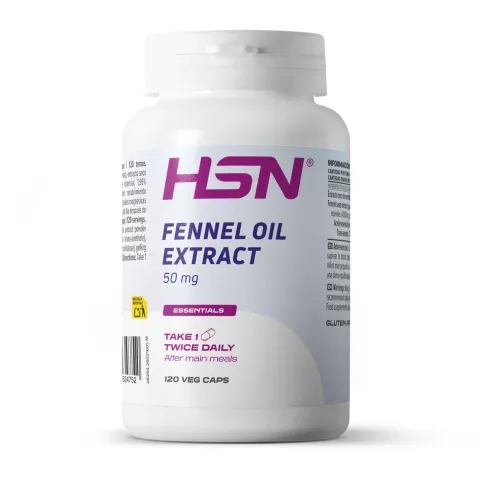
Anise Extract (20:1) 100 mg from EssentialSeries is a plant-based dietary supplement in vegetable capsules made with dried extract of anise, Foeniculum vulgare, concentrated 20:1. Each 100 mg of extract equals 2000 mg of anise seeds used as raw material.
Additionally, it is standardized to 50% essential oil and 1.95% trans-anethole. This standardization profile is verified by HPLC analysis, an analytical technique that confirms the declared content of the characteristic compounds of the raw material.
This means we’re not dealing with plain ground anise. We’ve used a concentrated extract, with a defined profile, standardized and analytically controlled, so that each capsule provides a raw material of interest from a compositional point of view.
A convenient way to take anise in capsules, with an equivalence of 2000 mg of seeds, standardized and verified by HPLC, and a clean label formula, without adding anything that doesn’t add value.
What makes it different from normal ground anise
Ground anise is normally obtained by milling the plant. It’s a simple option, but its concentration can vary a lot and doesn’t always allow detailed knowledge of its content in characteristic compounds.
In this product we chose a 20:1 dried extract. In simple terms, you start from a larger amount of plant material to obtain a smaller amount of final extract. Practically, the 100 mg of extract per capsule equals 2000 mg of anise seeds used as raw material. The result is a much more concentrated form and easier to dose inside a capsule.
The differential value isn’t only in the 20:1 concentration. Also, the extract is standardized to 50% in essential oil and 1.95% in trans-anethole. This standardization to specific parameters makes a clear difference compared to products that only indicate the presence of anise or its extraction ratio without declaring the content of its characteristic compounds.
The aromatic part of anise is one of the plant’s most valued, and trans-anethole is one of its most representative compounds. That’s why we indicate its content and verify the standardized profile by HPLC analysis. This provides transparency and allows you to know more precisely what profile the raw material we use has.
Essential oil, but in dry format
One of the keys to this formula is that we don’t use pure essential oil as such, but a dried extract with a standardized content of 50% essential oil. This has a clear advantage for the product format: it allows working with a concentrated raw material, but without relying on an oily format or soft gels.
The result is a more practical dietary supplement, with a fully clean label formulation and more versatile for day-to-day use. We ensure the essential oil value of anise, with standardized verification by HPLC, but in a dry format, stable and easy to integrate into a vegetable capsule.
- 100 mg of dried anise extract 20:1.
- Equivalent to 2000 mg of anise seeds.
- Standardized to 50% in essential oil.
- With 1.95% trans-anethole.
- Standardization verified by HPLC analysis.
- Vegetable capsules with delayed release.
- Vegan, clean label and allergen-free.
- No additives for aesthetic reasons.
Vegetable capsules with delayed release
We’ve used delayed-release vegetable capsules to protect the content until the point in the digestive system where it can be released. It’s a very useful technology when working with sensitive ingredients that can be affected by the stomach’s acidic environment.
It also fits the EssentialSeries philosophy: clear, convenient formulas, well thought out, without making them more complex than necessary.
Properties of anise
Anise supports normal urinary elimination functions, contributes to urinary flow, supports kidney excretory function, supports detoxification systems, promotes urinary elimination and supports renal elimination functions.
It also helps support digestion, supports appetite, digestion and elimination, and supports digestive tract health. In addition, it supports the immune system and shows antioxidant activity.
In women, anise helps maintain a comfortable menstrual cycle, helps maintain a calm and comfortable menopause, and helps women cope with signs associated with menopause, such as hot flashes, sweating, restlessness and irritability.
Who it’s recommended for
This dietary supplement can fit people looking for an easy way to take quality anise in a convenient format. It’s a practical option for those who prefer concentrated extracts, plant-based formulas and products with a clear composition.
It’s also a good alternative for those who value standardized botanical extracts, with content verified by analytical techniques like HPLC, and want to know what they’re taking, without formulas overloaded with unnecessary additives.
How to integrate it into your routine
Its capsule format makes it easy to take as part of a daily routine, especially if you already use other digestive wellness supplements or dietary supplements for self-care.
It can be integrated at convenient times of the day, always following the directions on the package, after meals. Since it has no intense flavor or prior preparation, it’s a more practical option than infusions, seeds or vegetable powders.
Recommended combinations
If you’re after a more complete routine, you can combine it with Digezyme® 200 mg, a veggie enzyme blend, or with Gzymes®, a proprietary HSN formula with selected enzymes.
It can also fit alongside GI Biotics if you want to complement your routine with bacterial strains, or with Psyllium Husk 700 mg, a plant option in capsules for those looking to add fiber to their day-to-day.
For a simple nutritional base, you can use it together with Magnesium Citrate or Magnesium Bisglycinate, two minerals easy to fit into a daily routine.
Frequently asked questions
Is it the same as taking anise in a tea, for example?
No. We’ve used a 20:1 dried extract, a more concentrated form than ordinary powder. Each capsule provides 100 mg of extract, equivalent to 2000 mg of anise seeds. Also, it’s standardized to 50% in essential oil and 1.95% in trans-anethole, with a composition profile verified by HPLC analysis.
What amount of anise seeds does it correspond to?
The 20:1 ratio means 20 parts of anise seeds are used to obtain one part extract. That’s why the 100 mg of extract present in each capsule equals 2000 mg of anise seeds used as raw material.
Why don’t we use pure essential oil?
Because pure essential oil requires oily formats, like soft gels. Here we’ve chosen a dried extract with 50% essential oil content, which allows working in vegetable capsules and keeping a practical and clean label formula.
What does it mean that it’s standardized?
It means the extract is controlled to provide a specific amount of certain compounds. In this case, 50% essential oil and 1.95% trans-anethole. This standardized profile is contrasted by HPLC analysis, which allows analytically verifying the declared content and offering more transparency and control over the raw material.
What does delayed release contribute?
It helps protect the capsule’s content until the point of the digestive system where it should be released. It’s a practical way to protect the ingredient inside the capsule format.
Why choose HSN’s anise extract (20:1)
Because it’s not just any anise. Each capsule provides 100 mg of dried extract 20:1, equivalent to 2000 mg of anise seeds, a concentration hard to reach using seeds, infusions or regular ground anise.
Also, it’s standardized to 50% in essential oil and 1.95% in trans-anethole. A defined profile verified by HPLC analysis that lets you know more precisely the composition of the raw material used.
A clean label, vegan, allergen-free and without unnecessary additives, in delayed-release vegetable capsules, designed for those seeking a concentrated, standardized, convenient and easy-to-integrate botanical option into their daily routine.
Bibliography
- Badgujar, S. B., Patel, V. V., & Bandivdekar, A. H. (2014). Foeniculum vulgare Mill: A Review of Its Botany, Phytochemistry, Pharmacology, Contemporary Application, and Toxicology. BioMed Research International, 2014, 842674.
- Shahat, A. A., Ibrahim, A. Y., Hendawy, S. F., Omer, E. A., Hammouda, F. M., Abdel-Rahman, F. H., & Saleh, M. A. (2011). Chemical Composition, Antimicrobial and Antioxidant Activities of Essential Oils from Organically Cultivated Fennel Cultivars. Molecules, 16(2), 1366-1377.
- Alajmi, M. F., Alam, P., Shakeel, F., & Foudah, A. I. (2022). Simultaneous Determination of Fenchone and Trans-Anethole in Essential Oils and Methanolic Extracts of Foeniculum vulgare Mill. Fruits. Separations, 9(5), 132.
- Díaz-Maroto, M. C., Pérez-Coello, M. S., Esteban, J., & Sanz, J. (2006). Comparison of the Volatile Composition of Wild Fennel Samples from Central Spain. Journal of Agricultural and Food Chemistry, 54(18), 6814-6818.