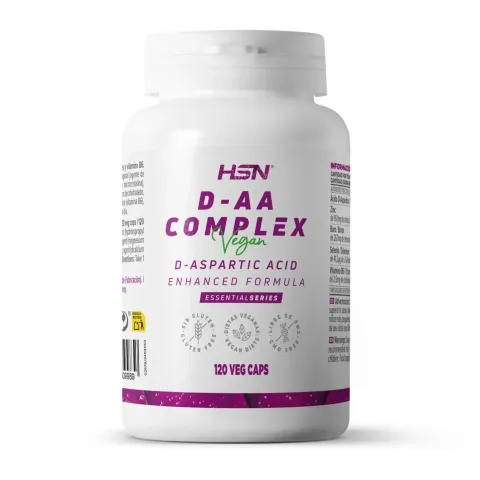
What is D-AA (D-aspartic acid) 1000 mg complex?
D-AA (D-aspartic acid) 1000 mg complex from EssentialSeries is our D-aspartic acid food supplement with zinc, boron, selenium and vitamin B6. We’ve brought these ingredients together in vegetable capsules to give you a convenient combination that’s easy to fit into your daily routine.
D-aspartic acid, also known as D-AA or DAA, is one form of the amino acid aspartic acid. It occurs naturally in the body and is distinct from the L-form commonly found in food proteins.
In this complex, we use the amino acid in its base or free form. From there, our team has developed a formula with other ingredients while keeping the convenience of a format that’s ready to take with water.
An amino acid with decades of history
The scientific history of D-AA began long before it appeared in sports nutrition catalogues. For a long time, amino acid research focused mainly on L-forms, which are known for being part of proteins.
In 1977, researchers D’Aniello and Giuditta published one of the classic studies on the natural occurrence of D-aspartic acid. This study helped spark interest in D-series amino acids and their presence in living organisms.
As analytical techniques advanced, D-AA could be identified and studied more closely, including in human tissues. Today, decades of published research help us understand its structure, its distribution in the body and how it differs from other amino acids.
Free-form D-AA and D-AA salts: what’s the difference?
When you look for D-aspartic acid, you may find the ingredient in different forms. One is the base or free form, which we’ve chosen for this complex. Others are its salts, where aspartate is combined with a mineral, as in calcium D-aspartate.
The difference becomes clearer when you look at their composition. In a calcium salt, the ingredient’s weight includes both the amino acid and the calcium. Some forms also contain water in their crystal structure, as is the case with hydrated forms.
That’s why the total weight of a D-AA salt and the amount of D-aspartic acid it provides are different figures. Two raw materials of the same weight can provide different amounts of the amino acid, depending on their composition.
For our complex, we choose free-form D-AA and select the accompanying minerals separately. This lets us define the ingredient combination and list the amounts of the amino acid and each mineral independently.
A formula that pays attention to the details
D-aspartic acid is the main ingredient in the formula. We combine it with zinc, boron, selenium and vitamin B6 for anyone who prefers to get these ingredients in one food supplement.
For the zinc, we’ve selected zinc citrate, a compound that combines this mineral with citric acid. It’s a source of zinc whose absorption has been studied and is among the raw materials we’ve chosen for this product.
Zinc, selenium and vitamin B6 each bring nutritional benefits to the formula:
- Zinc contributes to the maintenance of normal testosterone levels.
- Vitamin B6 helps reduce tiredness and fatigue.
- Selenium contributes to the protection of cells from oxidative damage.
We also take care with the information provided about the product. Our clean label lists the ingredients and the amounts they provide, distinguishing the amount of each mineral from the amount of the compound used to add it.
That detail is especially useful for ingredients such as zinc citrate: it shows how much zinc the formula actually provides, as well as identifying its source within the formula.
HSN quality: from ingredient to finished product
Quality starts with choosing the raw materials. At HSN, we evaluate our suppliers and work with ingredients documented through certificates of analysis and checks designed to verify their composition, purity and quality.
During manufacturing, we carry out process and weight checks and record the information associated with each batch. We also check the finished product before approving its release. This oversight lets us maintain traceability and review the different stages of production.
Our team is involved in developing the formula, choosing the ingredients and the manufacturing process. That involvement shapes specific decisions: which form of D-AA we use, how we add the minerals and what information we make available to you.
Find out more about our work on the HSN quality guarantee page.
Who is it for, and how do you take it?
We’ve developed it for adults looking for D-aspartic acid who prefer a combined formula in capsules. It may be a good fit if you’re already familiar with this ingredient and like the convenience of having it alongside minerals and vitamin B6.
The capsules make it easy to take at home, at work or while travelling. Take them with water, with no preparation needed — handy when you want to keep your routine simple.
To fit it into your day, follow the directions for use on the pack and choose a time that works for you. Our formula and the vegetable capsule shell are suitable for vegetarians and vegans.
Other D-aspartic acid options at HSN
The format and the ingredients paired with D-AA may influence your choice. Alongside this complex, you’ll find the amino acid on its own or combined with a different selection of minerals in our catalogue.
D-aspartic acid powder from RawSeries
Our D-aspartic acid powder from RawSeries contains only this ingredient: free-form D-AA, 100 % pure and with no additives.
It’s an option if you prefer to take the amino acid separately and choose the rest of your nutritional supplements independently. The powder can be mixed with water or your usual drink.
It comes without flavourings or sweeteners and retains the ingredient’s naturally acidic taste. If you prefer a ready-made combination with minerals and vitamin B6, D-AA complex capsules offer that format.
Evozma: D-AA with magnesium, zinc and vitamin B6
Evozma from SportSeries is another of our formulas with D-aspartic acid. Here, we combine it with magnesium, zinc and vitamin B6 in vegetable capsules.
For this combination, we use magnesium as citrate and zinc as chelated bisglycinate. It may appeal to you if you’re looking for magnesium alongside D-AA, zinc and vitamin B6.
D-AA complex, D-AA powder and Evozma give you options based on the formula and format you prefer: a combination with zinc, boron, selenium and B6; the amino acid on its own; or a combination with magnesium.
What can you combine D-AA complex with?
If you train and want to add other products for your sports nutrition to your order, you could choose Evowhey protein. It’s a practical way to add protein to meals through shakes or recipes such as yoghurt, porridge and pancakes.
Another option is our creatine monohydrate powder from RawSeries if you want to add creatine to your sports nutrition plan. Its unflavoured format makes it easy to add to water or your usual shake.
Frequently asked questions
What does the D in D-aspartic acid mean?
The D identifies the orientation of its structure. The D- and L-forms have the same components but a different arrangement, a bit like a hand and its mirror image. That difference makes them distinct forms of the same amino acid.
Is the aspartic acid in food the same as D-AA?
The aspartic acid found in food proteins is usually in its L-form. Our product specifically contains the D-form, known as D-aspartic acid.
Are zinc citrate and zinc the same thing?
Zinc citrate is the compound we use to provide the mineral. Its weight includes both the zinc and the rest of the compound. That’s why we distinguish between the two and specify how much zinc the formula provides.
Why choose capsules instead of powder?
Capsules offer a ready-made combination that you can take with water. RawSeries powder lets you choose D-aspartic acid as a standalone ingredient and mix it with a drink. Pick whichever best suits your routine.
Choose D-AA complex if you’re looking for free-form D-aspartic acid, selected minerals and vitamin B6 in a convenient format. A vegan-friendly combination developed by HSN and backed by our work in ingredient selection, manufacturing and quality control.
References
- D’Aniello, A. and Giuditta, A. (1977). Identification of D-aspartic acid in the brain of Octopus vulgaris Lam. Journal of Neurochemistry, 29(6), 1053–1057. DOI: 10.1111/j.1471-4159.1977.tb06508.x.
- Kiriyama, Y. and Nochi, H. (2016). D-Amino Acids in the Nervous and Endocrine Systems. Scientifica, 2016, 6494621. DOI: 10.1155/2016/6494621.
- Maeda, M. and colleagues (1990). Complex formation of calcium(II) with amino acids under physiological conditions. Journal of the Chemical Society, Dalton Transactions. DOI: 10.1039/DT9900002337.
- Wegmüller, R. and colleagues (2014). Zinc Absorption by Young Adults from Supplemental Zinc Citrate Is Comparable with That from Zinc Gluconate and Higher than from Zinc Oxide. The Journal of Nutrition, 144(2), 132–136. DOI: 10.3945/jn.113.181487.